

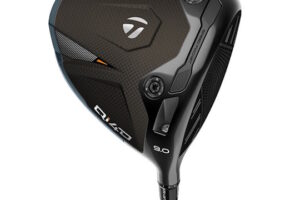
In this review, I’ll be taking a comprehensive look at the TaylorMade Qi4D driver.
The Qi4D is designed to be TaylorMade’s fastest and most fittable family of drivers. The standard Qi4D model, in particular, is designed to provide a blend of forgiveness and distance, thus appealing to a wide range of golfers.

While the Qi4D carries forward a number of key TaylorMade technologies from past driver models, it makes a number of improvements over the previous-generation Qi35 including a refined shape, improved roll radius, and new shaft fitting process designed to help you optimize performance better than ever.
How does the Qi4D driver actually perform when put to the test? How does it compare to the Qi35 driver? Who is it best suited for? Is it worth putting in the bag?
Here’s what will be covered in the review:
- Ratings
- Features & Tech
- Performance
- Looks
- Sound & Feel
- Where To Buy Online
- Final Thoughts
Read on to learn what you need to know to make an informed purchase.
Note: Unless otherwise stated, stock shafts and stock grips are used when evaluating this club. In most cases, the golf clubs reviewed on Golfstead are acquired temporarily for testing purposes and are not purchased. The review that follows is based on the personal experience and research of the author. Because everyone’s swing and body are different, results with a particular club may differ from person to person.
What are the reviews like?
Because of the newness of this release, reviews of the Qi4D driver are limited.
However, the critic and user feedback that is out there right now is extremely positive. The driver currently has a 5/5 user rating on the TaylorMade store.
What People Like
- impressive clubhead speed
- significant distance gains over past models
- great feel in the hands
- forgiving and stable
- nicely balanced look at address
What People Don’t Like
- overall aesthetic isn’t radically different from previous TaylorMade drivers
The Features
Compared to the Qi35, the Qi4D driver has been redesigned based on computer simulations and feedback from pro players. The aerodynamics of the head have been further optimized to minimize drag through the swing.
Improved Roll Radius
One notable change with the Qi4D is a new and improved roll radius. It’s tighter this time around, reducing spin variation across the face by over 30% on average.
Spin is now more consistent at different vertical contact points on the face. Spin consistency is most improved higher on the face, at nearly 50%.
This produces more consistent results when you stray from the center of the face.
Trajectory Adjustment System
As opposed to the dual-weight system of the Qi35, the Qi4D features four TAS weights (two 4g and two 9g) for another layer of adjustability.
These weights can be swapped to:
- add forgiveness (heavy weights back)
- reduce spin (heavy weights forward)
- add a slight fade bias (heavy weights on the toe side)
- add a slight draw bias (heavy weights on the heel side)
New Shaft Fitting Process
TaylorMade offers special Mitsubishi REAX stock shafts (developed using Mitsubishi Chemical’s world-class expertise, production processes, and materials) for the Qi4D driver based on the type of swing rotation you have.
You will go through this process as a matter of procedure if you are being fit for a Qi4D driver. If you’re not being custom-fit to the Qi4D, you can record your swing face on and observe your rotational position at impact.
- body releases faster than the club: recommended to play the low-rotation option
- body and club are roughly in sync: recommended to play the mid-rotation option
- club releases faster than the body: recommended to play the high-rotation option
This allows you to play a shaft that matches your unique swing profile.
Other tech to note includes:
- 60x Carbon Twist Face: 60 layers of carbon sheets are strategically arranged to maximize energy transfer and ball speeds in all regions of the face. This tech also improves directional forgiveness when contact is made towards the heel and toe.
- Thru-Slot Speed Pocket: this flexible pocket, redesigned for the Qi4D, reduces spin and increases sole flexibility, leading to increased ball speed and forgiveness low on the face.
- Multimaterial Construction: allows weight to be placed in strategic areas to maximize overall performance.
- Infinity Carbon Crown: this special carbon crown design extends virtually all the way to the top line to cover nearly all of the top of the driver, enabling weight savings that are redistributed to increase MOI.
Stock Info
The Qi4D driver is available in 8°, 9°, 10.5°, and 12° standard lofts at 460CC.
Included is a 4° loft sleeve that allows you to adjust loft, lie and face angle. There are 12 possible sleeve variations that can increase or decrease the loft and lie angle by ±2°, and the face angle by ±4°.
The Qi4D is also available in a Qi4D LME (Launch Monitor Enabled) variant. It’s the same as the regular Qi4D but has reflective fitting markers embedded into the carbon face. The Qi4D LME is designed for official TaylorMade fittings that use the GCQuad launch monitor, eliminating the need to manually place stickers on the face.
The stock graphite shafts (based on rotational profiles as outlined above) are the Mitsubishi REAX 50 High Rotation Red, Mitsubishi REAX 50 Mid Rotation Blue, and Mitsubishi REAX 60 Low Rotation White. The stock grip is the Golf Pride ZGRIP Plus2.
If you’re interested, full information on the driver, shafts, grips, their specs, and any custom options can be found here.
Below are the specs of the Qi4D driver. Click or zoom to enlarge.

The Performance
In the sections that follow, I’ll talk about my experience with the Qi4D driver. Let’s jump right in.
Distance
When I reviewed the Qi35, I found distance and ball speeds to be unremarkable relative to its predecessor, the Qi10.
That’s not the case this time. In terms of averages, ball speeds are about 0.6-1 mph greater than the Qi35. The end result for me during my testing session was 5-7 additional yards of carry and 9-13 additional yards of total distance.
I also saw clubhead speed gains of around 1 mph on average. In fact, it appears that most of the gain in ball speed and distance is due to improved aerodynamics and clubhead speed.
Forgiveness
From an objective standpoint, the MOI of the Qi4D is lower than the Qi35, so you would expect it to not be quite as forgiving. This was already signaled as soon as I observed the more pear-shaped footprint of the driver.
In practice, forgiveness levels appear to be quite similar to the Qi35. While ball speed retention in mis-hit areas is a little worse this generation, directional forgiveness when struck towards the toe/heel or high/low on the face is just as good, if not a little better.
This is largely due to the improved roll radius, which delivers more consistency from shot to shot. And, naturally, you get a nice little bump in forgiveness when you have a back-weighted TAS configuration.
Playability/Trajectory
TaylorMade classifies the Qi4D as having a mid-high launch and mid-low spin. My testing is more or less consistent with this.
Interestingly, I get a slightly higher launch with the Qi4D compared to the Qi35, assuming an equivalent weight balance in the sole. I expected a marginally lower launch due to the lower MOI of the driver, but it wasn’t the case for me.
Spin rates are, for the most part, about the same as the Qi35. Putting the heavy weights in the toe or heel side will produce a minor fade or draw bias of a few yards. The driver is generally more workable than the Qi35.
It’s nice to have additional weights in the TAS system (four instead of two), as this allows for possible draw and fade biases in addition to forward-weighted low spin and back-weighted stability options. Although, it does seem that putting the two 9g weights forward has less of a spin-reducing effect than the previous generation.
The Look
The Qi4D driver continues the industry trend away from titanium and towards carbon, with a carbon face and carbon body. The matte finish makes the overall aesthetic a bit more understated.
One of the most noteworthy aspects of the Qi4D is that it has more of a traditional pear shape compared to the Qi35. I felt that the Qi35 had too much of a stretched profile, so it’s nice to see a clearer differentiation from the Qi4D Max.
The sole design of the Qi4D is quite different from the Qi35, and I personally prefer it. The TaylorMade logomark in the middle makes it visually clear which brand you’re playing, but at the same time, the sole doesn’t feel as busy as the previous generation.
Another noticeable change is the rearrangement and addition of weight ports. The Qi35 had one weight in the center, but the Qi4D puts one towards the heel and one towards the toe, as well as adding an additional port at the back of the Inertia Generator.
Also returning this generation is the high-contrast alignment line above the face and the Infinity Carbon Crown. A cool blue back and a couple of small orange accents give the dark-grey dominant Qi4D some pop.
The Sound & Feel
The feel of the Qi4D driver is similar to the Qi35 (as well as the Qi10 and Stealth 2 models) when it comes to power and responsiveness at impact. However, I find the Qi4D to strike a notably softer note that is really satisfying.
The sound at impact is a medium-pitched, crisp “snap” that is well balanced in its acoustics. It’s not much different from the Qi35 although it does seem to be just a touch quieter and more muted.
The consistency of feel and sound across the face is about what you would expect for the balanced “middle” model in the Qi4D family. Moderate and severe mis-hits will make themselves known to you quite clearly, but without unnecessary harshness or punishment through the hands.
Where To Buy This Driver Online
You can order a Qi4D driver with your choice of loft and shaft, or optionally do a full customization, on TaylorMade’s official store. Get the LME variant here.
Another option is Global Golf. They offer a 90-Day Performance Guarantee, club trade-ins, and other incentives designed to enhance the buying experience.
You can also buy the Qi4D driver from PGA TOUR Superstore, Amazon, or Golf Galaxy.
Don’t forget about eBay, where you can often find unbeatable deals on new and used golf equipment.
Final Thoughts
If there was ever a time when upgrading to the next generation of driver was worth it, this is it.
Relative to the Qi35, the TaylorMade Qi4D driver generates more clubhead speed and more distance, and despite its more traditional pear shape at address, it’s practically just as forgiving.
I’m awfully impressed with what the Qi4D puts out in terms of distance. It’s right up there amongst the longest drivers on the market for 2026.
That’s not to mention the richer TAS sole adjustability and new shaft fitting process that will make it easier than ever for golfers to find the configuration that is perfect for them, thereby unlocking the full potential of the driver.
While the new three-category system TaylorMade has devised for choosing your shaft is not a substitute for a professional fitting that considers a wide spectrum of possible custom shafts, it’s certainly better than just going into it blind and trusting your gut. I believe it will be very helpful to more casual players who tend to buy their clubs off the rack.
The Qi4D is viable for a wide range of skill levels, but if your handicap is north of 20, I suggest trying out the Max or Max Lite models as well.
Learn More About Golf
If you want to learn more about golf, check out these other helpful resources!
Popular Buying Guides